
Search
CLOSEIntegrated Multi-Omics and Liquid Biopsy Approaches for Prognosis and Therapy Selection
Dr. Alexandra Voutsina
Our laboratory explores the genetic and phenotypic heterogeneity of human diseases using state-of-the-art omic technologies, with the goal of uncovering mechanisms of therapy resistance and advancing strategies for prevention, early diagnosis, and minimal residual disease (MRD) monitoring. By applying next-generation sequencing (NGS) to tissue and liquid biopsy samples, we identify somatic genetic alterations associated with disease progression, treatment response, and intra- and inter-tumor heterogeneity. We design and validate high-sensitivity assays—such as PCR-PNA clamping—for the precise detection of rare variants and MRD. Beyond patient sample analysis, we employ advanced cell-based and animal models, developed through interdisciplinary collaborations, to investigate disease mechanisms, validate molecular findings, and test therapeutic interventions in a controlled environment. In close coordination with bioinformatics teams, we implement robust analytical pipelines for the interpretation and classification of genetic variants, following ACMG/AMP guidelines and incorporating population data, clinical databases, and predictive in silico tools to ensure accurate and clinically actionable reporting.
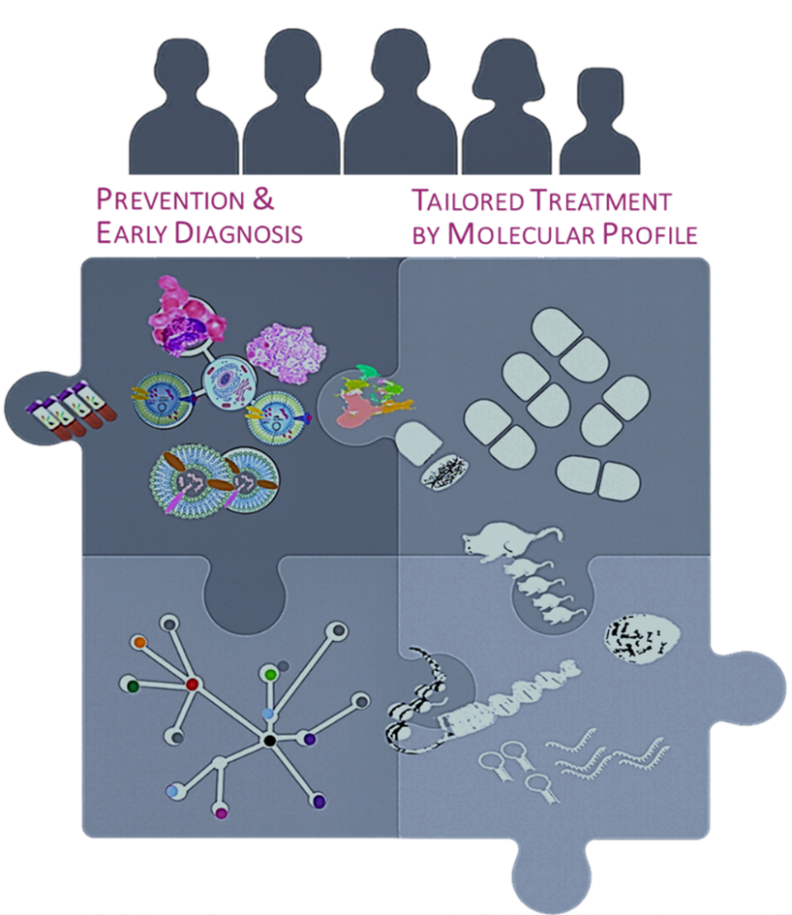
Current Research Activities
One of our key research directions focuses on tumor heterogeneity and its role in cancer evolution. Tumors consist of genetically diverse subclones, with distinct mutational profiles that influence their capacity to evade the immune system, metastasize, and resist treatment. We investigate this complexity by comparing molecular profiles from different tumor regions (core and periphery), involved lymph nodes, and matched plasma samples using next-generation sequencing and high-sensitivity assays. Through this multi-site and liquid biopsy approach, we aim to understand how selective pressures shape tumor evolution over time and to identify biomarkers for early detection, prognosis, and therapeutic decision-making.
Our research focuses on leveraging liquid biopsy as a minimally invasive tool for the prevention and early detection of upper gastrointestinal cancers, enabling timely intervention and improved patient outcomes. Given the limitations of current imaging methods and the risks associated with pancreatic surgery, there is a strong need for non-invasive biomarkers to support risk stratification in individuals with pancreatic cysts and early detection of pancreatic malignancy. The aim is to identify reliable plasma-based biomarkers that can distinguish high-risk pancreatic cysts, enabling timely clinical decision-making while avoiding unnecessary surgical interventions. In this context, the team investigates extracellular vesicles (EVs) as carriers of genetic material with potential diagnostic value. This initiative is carried out in collaboration with specialized clinical units and aims to contribute to the establishment of a reference model for the surveillance and early intervention in high-risk populations.
Our research focuses on the mechanical properties of tumor cells and tumor-derived extracellular vesicles (EVs) as novel, universal biomarkers for early cancer detection. Changes in biophysical traits such as stiffness and deformability often occur in the earliest stages of tumor development—before molecular changes become detectable. While current technologies mostly analyze the mechanical characteristics of rare circulating tumor cells (CTCs), we extend this approach to include EVs, which are far more abundant and stable in the bloodstream. By combining analyses of both tumor cells and EVs through minimally invasive liquid biopsies, we aim to develop highly sensitive, broadly applicable diagnostic tools that can improve early cancer detection, monitoring, and patient outcomes across multiple cancer types.
Prof. Antonios Vezakis, Professor of Surgery at the National and Kapodistrian University of Athens and Aretaieio Hospital
Prof. Zoltán Wiener at the Department of Genetics, Cell and Immunobiology, Semmelweis University, Budapest, Hungary.
Dr. Maria Kandyla, Senior Researcher at the Theoretical and Physical Chemistry Institute (TPCI) of the National Hellenic Research Foundation (NHRF)
Dr Alexandra Voutsina has been awarded funding from the Bodossaki Foundation for her project on the prevention of pancreatic ductal adenocarcinoma (PDAC). This initiative is part of the Foundation’s Thematic Grants Programme, which supports health-related projects addressing primary preventive healthcare.
Google scholar: Alexandra Voutsina