
Search
CLOSETuning the nonlinear optical properties of MoS2 by interfacing with bay- or imide-substituted perylene diimides
Tuning the nonlinear optical properties of MoS2 by interfacing with bay- or imide-substituted perylene diimides
Eleni Nikoli, Ruben Canton-Vitoria, Georgios Skentzos, Efrosyni Pramatioti, Nathalie Zink-Lorre, Ana Maria Gutiérrez-Vílchez, Fernando Fernández-Lázaro*, Raul Arenal*, Stelios Couris*, Nikos Tagmatarchis*
ACS Appl. Mater. & Interfaces 2026, 18, 11825–11841
A study on tuning the nonlinear optical (NLO) properties of covalently modified semiconducting MoS₂ nanosheets, using bay- or imide-substituted perylene diimide (PDI) derivatives, entitled “Tuning the nonlinear optical properties of MoS₂ by interfacing with bay- or imide-substituted perylene diimides”, E. Nikoli, R. Canton-Vitoria, G. Skentzos, E. Pramatioti, N. Zink-Lorre, A. M. Gutierrez-Vilchez, F. Fernandez-Lazaro, R. Arenal, S. Couris, N. Tagmatarchis, was published in the highly prestigious and internationally leading journal in the field of applied nanomaterials, ACS Applied Materials & Interfaces 2026, vol. 18, pp. 11825–11841.
The co-authors of the publication include postdoctoral researchers Dr Eleni Nikoli and Dr Ruben Canton-Vitoria, as well as Research Director Dr Nikos Tagmatarchis.
The publication is the result of an international collaboration between TPCI/NHRF and the internationally renowned Universidad Miguel Hernandez de Elche (Spain), which specializes in the synthesis of chromophoric molecules; the CSIC–Universidad de Zaragoza, Instituto de Nanociencia y Materiales de Aragon and the Laboratorio de Microscopias Avanzadas (Spain), which specialize in the morphological analysis of nanostructured materials using advanced electron microscopy techniques; as well as the Institute of Chemical Engineering Sciences (ICE-HT) of FORTH, which specializes in the study of non-optical properties of advanced materials.
Within the framework of this research, the newly developed hybrid materials were thoroughly investigated using spectroscopic techniques (Raman, IR, UV-Vis, and PL), thermal analysis (TGA), electron microscopy (STEM-EDS), and electrochemical methods. In addition, their nonlinear optical response was evaluated under nanosecond and femtosecond laser excitation.
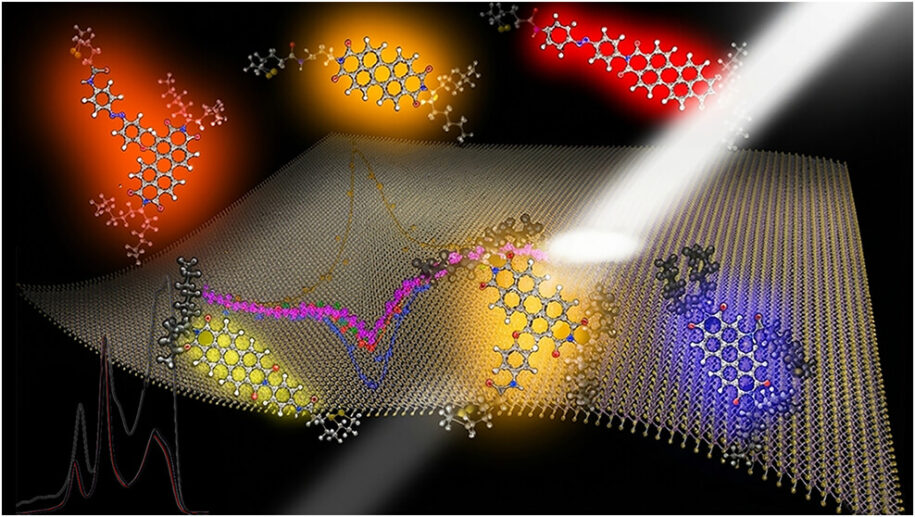
The new hybrid materials exhibited enhanced and tunable nonlinear optical (NLO) absorptive properties and NLO refractive responses compared with exfoliated MoS₂. The azobenzene-substituted PDI derivatives showed the strongest performance due to efficient electron transfer and resonant excitations. Furthermore, materials in which bay-substituted PDIs are attached to MoS₂ enhance π-conjugation and overall performance compared with the imide-substituted variants, enabling potential applications in optical limiting, mode-locking, and photonic devices.
Hybrid materials of this type, developed at TPCI/NHRF, advance optoelectronics based on two-dimensional transition metal dichalcogenides, overcoming the limits of light–matter interaction through molecular “antennas” based on perylene diimide. The present study highlights that the substitution position and the incorporation of azobenzene into perylene diimides are key parameters for optimizing the nonlinear optical properties in MoS₂-based hybrid nanoarchitectures.
Tuning the nonlinear optical properties of MoS2 by interfacing with bay- or imide-substituted perylene diimides
Eleni Nikoli, Ruben Canton-Vitoria, Georgios Skentzos, Efrosyni Pramatioti, Nathalie Zink-Lorre, Ana Maria Gutiérrez-Vílchez, Fernando Fernández-Lázaro*, Raul Arenal*, Stelios Couris*, Nikos Tagmatarchis*
ACS Appl. Mater. & Interfaces 2026, 18, 11825–11841