
Home Page About Location Contact  Sitemap
Greek  
 
 
  Programmes
  The Northern Greece Programme
  The Southern Greece Programme
  The Greek East Programme


The Greek East Programme

Members

The Greek East Programme is headed by the Senior Researcher I. Meimaris.

Other members include:
Garth Fowden, Director of Research
Antigone Zournatzi, Senior Researcher
Christina Kokkinia, Assistant Researcher
Kalliope Kritikakou, Functional Scientific Personnel

This programme emerged from the consolidation of the Palestine programme - founded in 1980 under the leadership of I. Meimaris - and the Hellenistic and Roman East programme founded in 1985 under the temporary leadership of the director of the KERA.
To the three already existing members of the programme (I. Meimaris, Garth Fowden, K. Kritikakou) was added Ch. Kokkinia in October 2004. The programme is now also formally joined by A. Zournatzi, a contributor to its projects since 2003, previously engaged in the programme of Northern Greece.

The Greek East programme undertakes research on:
A. the archaeology and epigraphy of late antique Palestine;
B. the cultural, intellectual and religious history of the Greek East;
C. Achaemenid Persia and the West;
D. government and society in Roman Asia Minor.

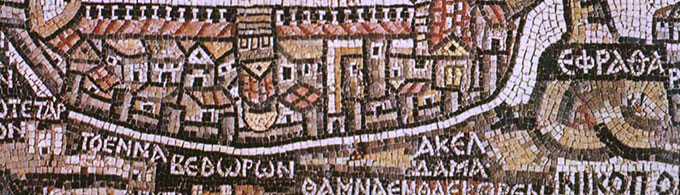
A. THE ARCHAEOLOGY AND EPIGRAPHY OF LATE ANTIQUE PALESTINE (I. Meimaris, K. Kritikakou)

1. This section is compiling an archive of the Greek inscriptions of Palestine (bibliography, squeezes, photographs, plans and maps), and is also preparing their publication in a corpus.

2. It also addresses the historical, archaeological and architectural study of sites or isolated monuments in Palestine, likewise the planning, photographing, conservation and study of sites or monuments belonging to Roman or early Byzantine Palestine, including the Sinai peninsula.
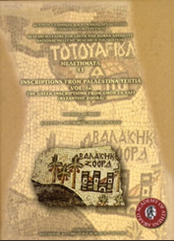
The main project on which this section is employed is the Corpus of Greek inscriptions of Palestine (I. Meimaris, K. Kritikakou), whose first volume, with the Greek inscriptions from Ghor es-Safi in Jordan, has already been printed, while a second volume will follow, with the Hebrew and Aramaic inscriptions.


B. CULTURAL HISTORY OF THE GREEK EAST (G. Fowden)

This section aims to investigate Greek culture and thought from its late polytheistic phase, through its patristic Christian period, down to the flowering of classical Islamic culture - based in part on translation of Greek texts - in the ninth and tenth centuries A.D. This research requires knowledge of literary texts, epigraphy, papyrology, archaeology, and the interaction of society and landscape throughout the eastern Mediterranean world. Increasingly it tends to view 'late antiquity' in the wider context of the first millennium. Some arguments for studying early Islam alongside late antiquity are offered in ΜΕΛΕΤΗΜΑΤΑ 37 by G. Fowden and E.K. Fowden: Studies on Hellenism, Christianity and the Umayyads (2004).

The work now being conducted aims to use the writings of the great neo-Platonist philosopher Plotinus to illustrate this more ambitious periodisation, by demonstrating the diachronic and cross-cultural action of his thought from the third to tenth centuries, in the Christian and Muslim as well as polytheistic worlds.

It is intended that the work of this section will eventually culminate in the production of a synthetic history of the period in question, or at least of a theme-oriented investigation of the whole period. In the medium term, it is also intended to produce a history of the late Roman Aegean, to which end a number of field missions have been conducted, and more are planned.


C. ACHAEMENID PERSIA AND THE WEST (A. Zournatzi)

Recent research on this wide-ranging subject of East-West interactions has chiefly focused on the political and cultural relations of the island of Cyprus with the Achaemenid Persian Empire and aimed at the preparation of a study entitled ''Persian rule in Cyprus: Sources, problems, perspectives'' (ΜΕΛΕΤΗΜΑΤΑ 44).

D. GOVERNMENT AND SOCIETY IN ROMAN ASIA MINOR (Ch. Kokkinia)

Thanks to its flourishing economy and intellectual life, Roman Asia Minor is a privileged field for study of the history of Hellenism. It bred the leading personalities of the Second Sophistic, while its cities both great and small were adorned with temples, theatres, gymnasia and other public monuments, which means that the literary sources can be eked out by a plethora of archaeological finds, especially inscriptions. Ch. Kokkinia's research centres on the Roman administration's relations with local society, and on the balance of power within the Greek cities between individual members and groupings within the local aristocracy, as also between aristocracies and the representatives of Roman authority. In this context Kokkinia has undertaken to study the inscriptions of Boubon, a Greek city in northern Lycia which flourished under Rome and was an active member of the Lycian koinon.
In parallel, Kokkinia is preparing a monograph on relations between the Greek cities of the East and Roman governors, based on epigraphical evidence.


Last Update: 29.07.2008
© National Hellenic Research Foundation (NHRF), 48 Vassileos Constantinou Ave., 11635 Athens, Greece, Tel. +302107273700, Fax. +302107246618